
Wayne Scott Release Outcomes
Wayne Scott Unit is a Texas Department of Criminal Justice Correctional Institutions Division prison for men. The official unit directory identifies a specialized mental-health custody role with inpatient mental-health beds. Its published capacity is 550. These facts describe an operating state facility, not an adult county jail.
Leaving Wayne Scott can mean transfer to another TDCJ unit, release to parole or mandatory supervision, or full discharge. A unit transfer remains incarceration. Parole and mandatory supervision place a person in the community while the sentence and state supervision continue. Discharge ends the TDCJ sentence. The current unit field and state status must be read together.
| Event | Custody result | Record route |
|---|---|---|
| Unit transfer | State custody continues | TDCJ offender search |
| Parole or mandatory supervision | Community under state supervision | TDCJ and Parole Division |
| Discharge | Sentence ends | TDCJ status or historical record |
Wayne Scott Mental Health Transfers
Scott’s mental-health mission makes destination checks especially important. A move from Scott to another TDCJ prison, an inpatient setting, or a medical unit can be treatment-related while state custody continues. The public record may update the Current Facility field without displaying the clinical reason, and protected medical information should not be inferred from a unit move.
For release verification, focus on status, date, and legal custody. A community placement under parole is different from a transfer for continued care. TDCJ records staff can confirm the custody trail, while parole staff confirm community supervision. The official unit directory supports the facility’s role but does not serve as an individual clinical record.
Confirm a Wayne Scott Release
Use the TDCJ Online Inmate Search. Search by a seven-digit TDCJ number, SID number, or name. Read Current Facility, Projected Release Date, Parole Eligibility Date, Maximum Sentence Date, and parole-review information as separate fields. A future projected date does not prove release, and a different unit name usually means transfer.
- Match the person with a TDCJ or SID number where possible.
- Check whether Current Facility still names Wayne Scott or another state unit.
- Read status and date fields without treating a projected date as an actual event.
- For parole, check TDCJ supervision channels. For a missing older record, request TDCJ history.
Email inmate-information questions to pia@tdcj.texas.gov. Include full name and TDCJ number, or exact birth date or approximate age and county of conviction. The general inmate locator numbers are 936-295-6371 and 800-535-0283, Monday through Friday, 8 a.m. to 5 p.m.
Wayne Scott Release Processing
The image below comes from the official Wayne Scott Unit directory and identifies the operating facility. TDCJ release processing is a state workflow. Release staff must resolve identification, legal status, detainers, supervision, and destination issues. County records may show the conviction that led to prison, but they do not replace TDCJ’s custody and discharge record.
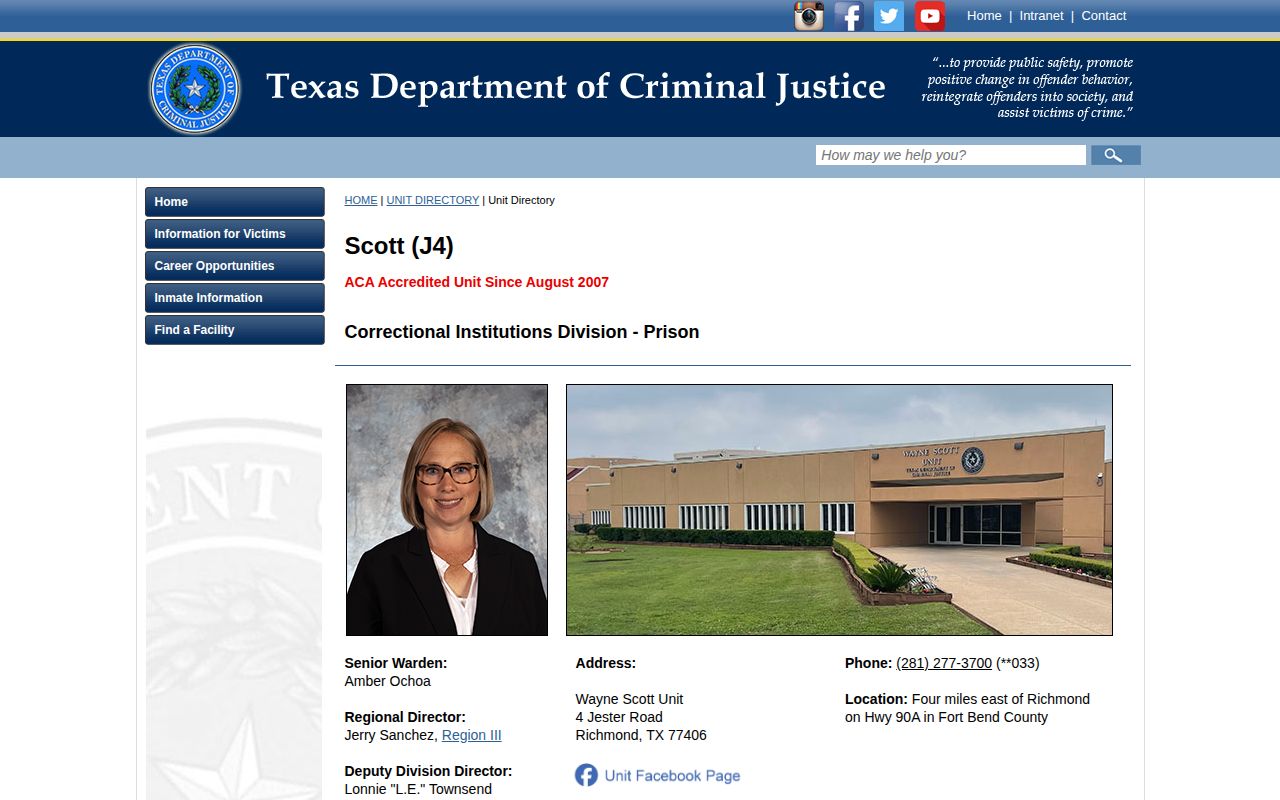
The unit source confirms Scott’s identity and role, while the statewide record establishes whether departure was a transfer, supervised release, or discharge.
A detainer is another authority’s request tied to custody. It can change the destination. Release from TDCJ therefore does not always mean an unqualified return home. Confirm the recorded destination and any new custodian.
Wayne Scott Records Contact
The unit can answer facility questions, while central TDCJ records and parole offices hold the durable statewide status trail.
Wayne Scott Unit4 Jester Road
Richmond, TX 77406
281-277-3700
Operator: Texas Department of Criminal Justice
The official Wayne Scott directory is the source for the unit’s current identity, address, phone, custody levels, and capacity. For historical documents, use TDCJ Public Information Act channels rather than FBCSO Records.
Fort Bend State Prison Context
Wayne Scott sits four miles east of Richmond on Highway 90A with Jester III and Carol S. Vance units. The live TDCJ directory identifies those three operating Fort Bend County state prisons. Jester I closed in 2020. Similar names in old documents can misdirect a search, so verify the unit code, J4, and the current facility field.
County court records can show the conviction and sentence. They do not show every later state transfer or release calculation. The Fort Bend released-inmate search explains when court records support a state lookup and when a county jail result addresses a wholly different custody event.
Wayne Scott Search Fields
TDCJ date fields answer different questions. Projected Release Date is the agency’s current estimate under its legal and record calculations. Parole Eligibility Date marks when review may become possible, not an approved departure. Maximum Sentence Date reflects the sentence endpoint shown in the state record. Parole-review information reports a separate process. None should be relabeled as an actual release date unless TDCJ says the event occurred.
A fully discharged person may no longer appear in the active public population. That limit makes the historical-record route important. Write to TDCJ with the person’s full name and seven-digit number, or an exact birth date or approximate age and county of conviction. Ask for existing incarceration, transfer, release, parole, and discharge information. A precise request is more useful than asking the agency to infer a complete history.
The county of conviction is a search aid, not the release custodian. Fort Bend court files may document the sentence imposed. TDCJ maintains the later state custody trail. Keeping those roles separate prevents a county disposition from being mistaken for proof of prison release.
Wayne Scott Parole Verification
Parole is conditional community release before the sentence has fully ended. When TDCJ records show parole, verify both the supervising office and current state status. Fort Bend County is served by the Rosenberg District Parole Office in Region III at 711 Highway 36 North, Rosenberg, TX 77471, telephone 281-232-0334. This office is not the Fort Bend County Community Supervision and Corrections Department, which administers court-ordered probation.
An absconder is a person alleged to have stopped complying with parole reporting and whose whereabouts are unknown to the Parole Division. Absconder or warrant information can change after release and may lead to later arrest. It does not change what the original prison departure meant. Use current TDCJ channels to verify the later status.
Wayne Scott Dates and Supervision
A projected release date is TDCJ’s current calculation, not a promise. Good-conduct time, parole review, mandatory-supervision rules, disciplinary changes, court orders, and detainers may affect timing. Texas does not impose one blanket rule requiring every prisoner to serve 85 percent. Offense-specific law controls.
If the person is released to parole in Fort Bend County, the Rosenberg District Parole Office is the local TDCJ supervision office. Probation is different. It is ordered by a court and administered locally, not by Wayne Scott or the TDCJ parole system.
Note: A move away from Wayne Scott proves only departure from that unit until the statewide record identifies the next status.
Wayne Scott Historical Records
An active TDCJ search is not a complete archive. A person who fully discharged may no longer appear in the public active population, and an older Wayne Scott stay may be only one part of a longer state custody history. The TDCJ Public Information Act route is the correct fallback. Ask for existing incarceration, transfer, release, parole, and discharge records tied to the person, not a newly created explanation.
Supply the full name and seven-digit TDCJ number when known. If it is not known, give an exact birth date or approximate age and the county of conviction. Request the actual release date, release mode, destination or receiving unit, and discharge status. Fort Bend court records can support identity and show a sentence, but they cannot establish every later state transfer.
The routine inmate-information email may provide the TDCJ number, location, conviction offense, prior incarceration history, current information, and projected date. It should not be assumed to contain every release field. Ask separately for the existing record that states the actual departure date, release mode, and discharge status.
Scott’s mental-health mission does not support guesses about an individual diagnosis or treatment. Those details may be private. A public-record check should stay with custody facts: unit assignment, transfer, release status, supervision, and discharge. This keeps the search focused on the facts TDCJ can verify without turning a facility role into a claim about one person’s health.
If the public result shows a different unit, record that unit and the date checked. Then contact TDCJ rather than Wayne Scott for the next event. This preserves a clear chain from Scott to the later custodian and avoids calling a transfer a release.