
Fort Bend 24-Hour Feed Is Absent
Fort Bend County has no official rolling page of people released today. The FBCSO Jail Public Information Inquiry is labeled for people who are in custody. Its form accepts a full or partial first name, last name, or both. It has no date control, release filter, archived-booking option, or 24-hour tab. A blank result can show that a person is no longer returned by the current inquiry, but it does not state why.
This distinction matters on the same day. The Bonding Office reviews the documents that authorize a departure. The official workflow identifies three destinations: TDCJ, another agency, or the street. Only the third is an uncomplicated community release. A TDCJ transfer remains incarceration, and another-agency transfer can reflect a warrant, court commitment, or other jurisdiction. Treat roster disappearance as a lead that needs a second source.
Check Fort Bend Releases Today
With no official same-day feed, use a short evidence chain. It starts with the current roster because that can establish whether FBCSO still reports custody. It ends with the office or receiving system that can explain the departure. For a search centered on one named person and older records, use the Fort Bend County released inmate search.
- Search the official Jail Inquiry with the name. Record the Jail ID and charge details if a current result appears.
- If the result recently vanished, contact the Bonding Office or Detention Bureau and ask whether the departure was to the street, TDCJ, or another agency.
- For documentary proof, submit a focused public-information request for booking and release data, including the name, jail ID or booking number, and the date range.
- Check Texas VINE for a county custody event. Use TDCJ search if staff identifies a prison transfer.
- Use the proper Fort Bend court clerk when the release rests on a bond, dismissal, judgment, sentence, or commitment.
The county warns that bonding information may not be available until roughly four hours after booking. That warning concerns the time after booking, not a four-hour refresh schedule for release data. A person booked and released quickly may require direct confirmation because no public recent-release archive bridges that gap.
Fort Bend Release Fields to Request
Because no public 24-hour table exists, there are no official same-day feed columns to reproduce. The live result shows current-custody fields, while a release request should name the administrative facts needed to establish what happened. Asking for precise fields reduces ambiguity and helps records staff identify the correct booking.
| Field | What it can establish |
|---|---|
| Name, Jail ID, booking number | Connects the request to the right jail event. |
| Book-in and book-out timestamps | Defines whether the booking ended within the requested 24-hour period. |
| Release destination | Distinguishes the street, TDCJ, or another agency. |
| Releasing authority or document | Identifies a bond, dismissal order, judgment, sentence, or commitment. |
| Charge disposition | Shows the recorded outcome tied to each charge when releasable. |
| Booking photograph | Identifies the image separately from the release facts. |
Not every requested item is guaranteed to exist or be public. The Inmate Processing Unit creates arrest, charge, identifying, and disposition records, while the Bonding Office reviews release documents. Describe both the booking packet and release event rather than asking for a vague “inmate report.”
Fort Bend Bond Release Destinations
The Detention and Bonding page explains that staff review cash, surety, and personal bonds, orders to dismiss, judgments and sentences, and court commitments. These records identify the legal basis for a departure. Posting bond does not decide the underlying case. It changes custody while the court case continues.
A street bond release may also lead to Fort Bend County CSCD Pretrial Bond Supervision when a judge orders it. Conditions can include testing, electronic or satellite monitoring, or an ignition interlock. That is different from TDCJ parole and from probation imposed as part of a sentence. For same-day verification, the jail departure record and the court order answer different questions and should not be treated as substitutes.
The county bonding workflow is shown in this official capture.
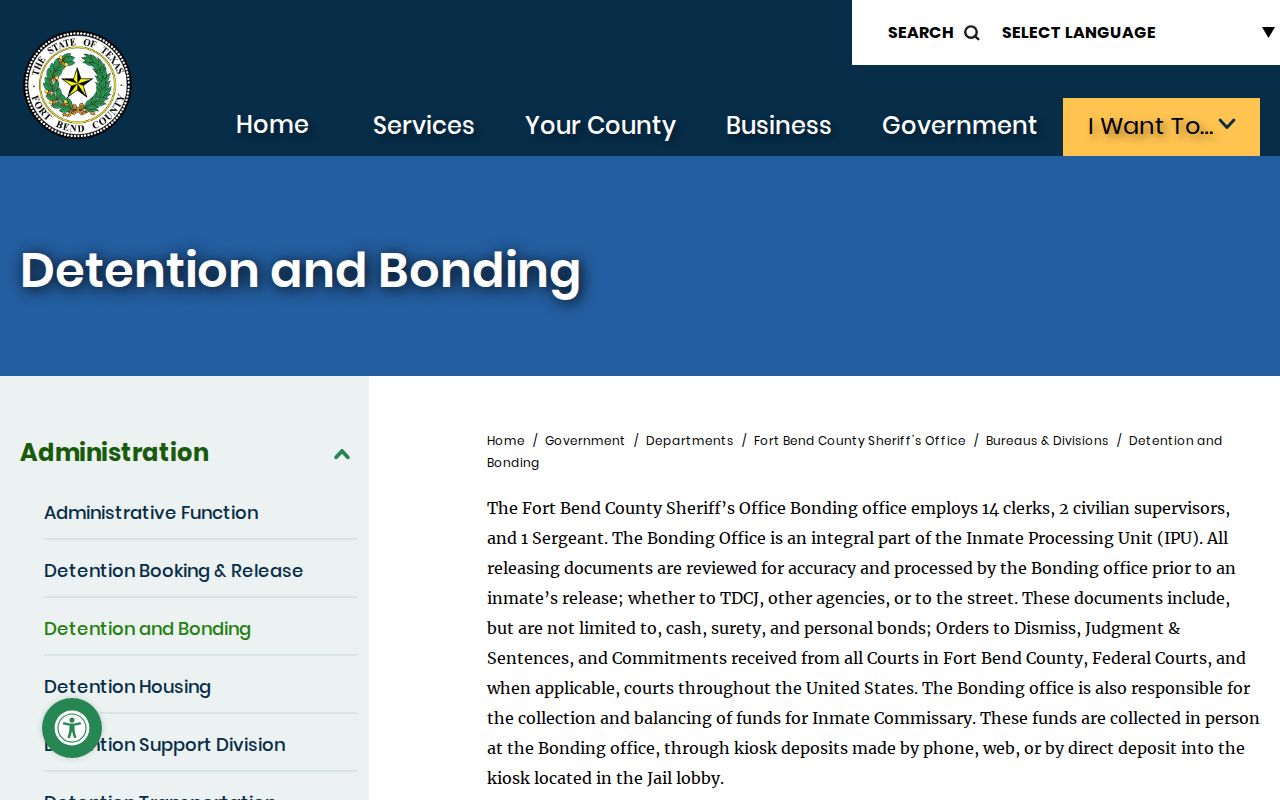
The image supports the key local distinction between release to the street and transfer into another custody system.
Current Inquiry Has No Archive
The public interface is designed around current custody. Its result card can show Name, Jail ID, age, race, sex, a mugshot area, and charge details such as the arresting agency, warrant, charge, bail type, bail amount, fines, and disposition. It does not show book-in time, release time, release reason, a projected date, or prior booking history. Those omissions prevent it from functioning as a Fort Bend County 24-hour release list.
The county’s official current-only inquiry notice can be reviewed here.
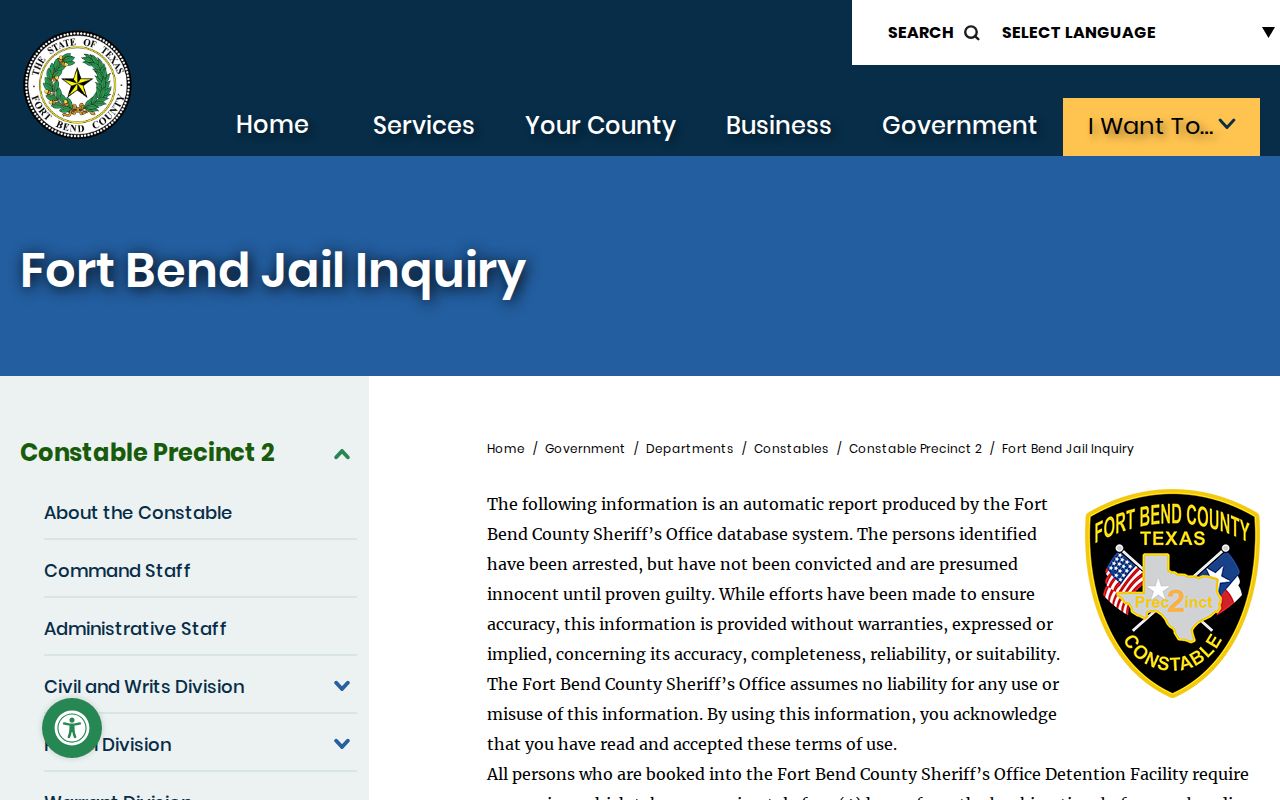
The capture reinforces why a name search alone cannot supply a verified list of releases today.
For a wider check, the Fort Bend 72-hour release list fallback explains how to span three days without treating the roster as an archive.
Fort Bend Sheriff App Limits
The “Fort Bend County Sheriff, TX” mobile app launched in 2024 with alerts, inmate resources, non-emergency reporting, and Jail Inquiry access. Its official description calls the jail feature current-inmate information with booking status and charges. It does not promise a recent-release list. The app is useful as another way to reach the same current-custody information, but it does not fill the missing 24-hour archive.
This is a local data quirk worth keeping clear. Sheriff apps in other counties may expose recent bookings or releases, but the Fort Bend app’s advertised scope is narrower. Do not infer a feed from the presence of an inmate feature. Use the county public-information channel when the public inquiry no longer returns a person and a record of the release is needed.
Released Versus Still in Custody
A live Fort Bend result means the person is reported in FBCSO custody at the time of the search. A missing result does not automatically mean freedom. The person may have gone to TDCJ, another county, federal custody, or ICE. Texas VINE can supply county custody notifications, but it is not the official record custodian. TDCJ’s offender search is the correct public route after a confirmed state-prison transfer. Federal BOP and ICE use separate national locators.
- Street release
- Departure from custody into the community, sometimes with bond or supervision conditions.
- Transfer
- Movement from FBCSO to another custodial agency.
- Discharge
- Completion of the controlling custody or supervision term.
- Disposition
- The recorded court outcome of a charge or case.
Use the release destination, not roster absence, as the deciding fact. That approach prevents a same-day custody transfer from being mislabeled as release.
Note: Court, jail, VINE, and TDCJ systems answer different questions and may update on different schedules.