
Fort Bend Detention Release Routes
The Fort Bend County Sheriff’s Office Bonding Office reviews every releasing document before it routes a person to the street, the Texas Department of Criminal Justice, or another agency. Those destinations carry very different meanings. A street release may follow a cash, surety, or personal bond, an order dismissing a charge, completion of a judgment or sentence, or another court document. A transfer to TDCJ means county-jail custody ended while state imprisonment began. A transfer to another agency can reflect a warrant, court commitment, or another jurisdiction’s hold.
The public Jail Inquiry is a current-custody tool. Once a name disappears, it does not show the release time, reason, destination, or prior-booking history. Confirm the outcome with the Bonding Office or request the booking-and-release packet. If the person moved overnight, detention personnel may have prepared a transfer to TDCJ, a state jail, or another agency.
| Route | Meaning | Best check |
|---|---|---|
| Street | County custody ended | Bonding or release record |
| TDCJ | State custody continues | TDCJ offender search |
| Other agency | Custody may continue | Receiving agency |
Confirm Fort Bend Jail Release
Start with the Fort Bend Jail Inquiry to see whether the person is still listed. Search by full or partial first or last name. A result can show name, Jail ID, race, sex, age, charge authority, warrant, charge, bail, fines, and disposition. It does not supply release fields. A blank search should trigger verification, not a conclusion.
- Record the exact name, Jail ID, booking number, and known booking date.
- Call the Bonding Office at 281-341-4619 and ask whether reviewed papers sent the person to the street or another custodian.
- Check TDCJ if a state transfer is possible, and contact the named receiving agency for any other transfer.
- Send a narrow written request for book-in and release timestamps, destination, releasing authority, document, disposition, and releasable photograph.
A person can leave the Fort Bend jail and remain confined elsewhere. The destination field is essential.
Fort Bend Release Records
The Sheriff’s Records Division accepts written public-information requests by email, mail, in person, fax, and the official mobile app. Use fbcsorecords@fbctx.gov, mail or visit 1410 Richmond Parkway, Richmond, TX 77469, or fax 832-471-2472. The Records Lobby is open Monday through Friday, 8 a.m. to 4 p.m., except county holidays. Records assistance is 281-341-4625.
Name an existing record rather than asking staff to decide what happened. A focused request identifies the subject, date range, Jail ID or booking number, then asks for the detention booking-and-release record, book-in and release time, destination or type, releasing authority and releasable document, charge disposition, and booking photograph. FBCSO asks for ten business days to respond, though large or complex matters may take longer. Copying and redaction can carry a fee, with notice in advance.
Texas Government Code Chapter 552 permits withholding or redaction where another law or a law-enforcement exception applies. Juvenile, medical, biometric, victim-identifying, sealed, expunged, and active-investigation material can be restricted. Ask for separable public portions and the cited legal basis for anything withheld.
Fort Bend Processing Operations
The official booking and release description divides the Inmate Processing Unit into Intake, Property, Imaging, Transport, Classification, and Bonding. Imaging records photographs, fingerprints, identifying marks, and arrest, charge, and disposition data. Property staff document and safeguard belongings. These functions explain why a complete release inquiry may require more than one record.
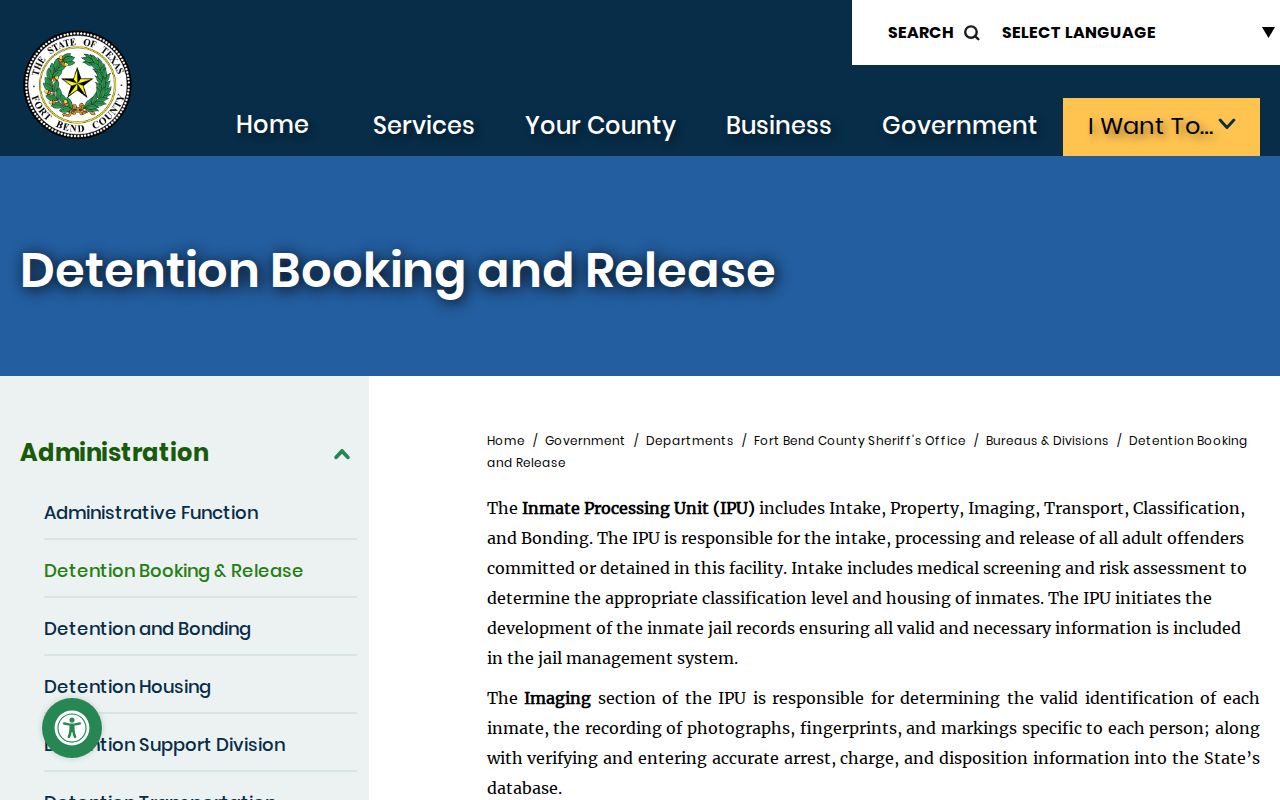
The official view ties the release event to reviewed documents and agency processing rather than to a simple roster disappearance.
Overnight detention staff also conduct counts, coordinate movement, and prepare overnight transfers. That detail is useful when one search goes blank before the receiving system updates. Timing gaps can occur between county departure and state or agency intake.
Fort Bend Detention Contact
Use the detention line for facility operations, Bonding for release routing, and Records for a durable document. Each office answers a different question.
Fort Bend County Sheriff’s Office Detention Facility1410 Richmond Parkway
Richmond, TX 77469
Detention: 281-341-4735
Bonding: 281-341-4619
Records: 281-341-4625
Records Lobby: Monday-Friday, 8 a.m.-4 p.m., except county holidays
The facility is the county’s adult booking and release point. It should not be confused with the nearby TDCJ prisons or the county juvenile system.
Fort Bend Release Documents
The release decision rests on reviewed papers, not on a name simply vanishing from the inquiry. The Bonding Office identifies cash bonds, surety bonds, personal bonds, orders to dismiss, judgments and sentences, and court commitments among the papers it processes. Each can lead to a different destination. A bond permits release under its terms but does not decide the pending charge. A dismissal order applies to the charge named in the order. A judgment or sentence may support time served, continued confinement, or transport required by a court.
Ask for the releasing authority and a releasable copy of the document when requesting the packet. Those items help distinguish a street release from transport. Also request the charge disposition recorded by the Inmate Processing Unit. A jail disposition can describe an administrative status at that point and should be compared with the final court record.
Property and imaging records answer related questions. Property staff safeguard belongings, while Imaging creates photographs, fingerprints, and identifying-mark records. A focused request can name these items separately because a basic release response may not include every part of the booking file.
Fort Bend Court Record Check
Fort Bend County uses separate clerk paths after release. The County Clerk covers Class A and B misdemeanors, Class C appeals, and the county’s unfiled misdemeanor search. The District Clerk holds felony cases and serves as official custodian for those court records. Search spelling, jurisdiction, and case number carefully. The local transfer of cases to the 501st and 502nd District Courts in 2026 shows why a changed case number or court assignment can create a false no-result.
Court access also has limits. Expunction and nondisclosure can restrict public information, but they are different remedies. An expunction uses the process in Texas Code of Criminal Procedure Chapter 55A. Nondisclosure restricts qualifying criminal-history disclosure under Government Code Chapter 411 and does not mean every underlying file was destroyed. Release from custody alone creates neither remedy.
After Fort Bend County Release
A bond release ends jail custody but does not end the criminal case. Court records may show the later disposition. Felony cases route through the District Clerk, while Class A and B misdemeanor matters route through the County Clerk. Probation is court-ordered community supervision. Parole follows release from TDCJ and is administered through the state system.
For a named adult whose county result vanished, the full Fort Bend County released-inmate search path compares the county record with court, TDCJ, VINE, federal, and immigration channels. Use only the channel supported by the person’s actual custody history.
Note: A release record can be incomplete or later corrected, so confirm the key event with the office that created it.