
Fort Bend County Released Inmates and Custody Endings
Fort Bend County has two custody layers that are easy to mix up. The Fort Bend County Sheriff’s Office operates the adult Detention Facility at 1410 Richmond Parkway in Richmond. TDCJ separately operates three active prisons in the county. A departure from the county jail may be a street release, a transfer to TDCJ, or a handoff to another agency. Only the first plainly means the person entered the community.
The sheriff’s Jail Public Information Inquiry is labeled for people in custody. It is useful for finding the booking identity, Jail ID, charges, bonds, fines, and dispositions while a person remains listed. It is not a discharge archive and has no release flag or timestamp. A missing name can reflect release, transfer, spelling, timing, or a different custodian.
How Fort Bend County Inmates Leave Custody
The FBCSO Bonding Office reviews the document that authorizes each departure. Its published examples include cash, surety, and personal bonds, dismissal orders, judgments and sentences, and commitments from county, federal, or other courts. The document and destination must be read together.
| Departure | Meaning | Next record |
|---|---|---|
| Cash, surety, or personal bond | Street release may occur while the case continues | Sheriff release event and court docket |
| Dismissal order | A court order may end the basis for that hold | Release record plus clerk’s case register |
| Judgment, sentence, or time served | The local jail term may end or lead to another sentence | Sheriff, court, and receiving-custodian records |
| Transfer to TDCJ | The county booking ends but incarceration continues | TDCJ offender record |
| Other-agency handoff | Another warrant, federal matter, county, or immigration custodian may take over | Receiving agency, BOP, ICE, or court record |
Note: A bond release ends physical detention on that booking, but it does not dispose of the criminal case.
What a Fort Bend County Release Record Can Show
A booking-specific administrative record is the best county evidence of what ended a jail stay. Ask for fields rather than asking the agency to draw a conclusion. FBCSO may redact protected content, and not every requested field is guaranteed to exist or be public.
| Field | What it shows |
|---|---|
| Full name, alias, Jail ID or P-number | Links the event to the correct person |
| Booking number and book-in time | Identifies the exact detention episode |
| Release date and time | Records when that county custody event ended |
| Release type or reason | May identify bond, dismissal, sentence completion, or other authority |
| Destination or receiving agency | Separates street release from transfer |
| Releasing authority and document | Connects the jail action to a bond, order, judgment, sentence, or commitment |
| Charge disposition | Shows the status entered for charges in the booking record |
| Booking photograph | Identifies the image associated with that booking, if releasable |
The live inquiry supplies a narrower current record: name, Jail ID, race, sex, age, an image area, and charge-table fields including agency, authority, warrant number, charge description, bail type and amount, fines, and disposition. It does not publish book-in time, release time, release reason, projected release, or prior-booking history.
Request a Fort Bend County Booking and Release Record
FBCSO accepts written requests by email, mail, in person, fax, or its mobile app. A narrow date range and booking identifier reduce ambiguity and possible cost. The county provides a form, but a clear written description of existing records is the key.
- Identify the person with full name, aliases if known, and the Jail ID or booking number. Add a relevant date range.
- Ask for the detention booking-and-release record, book-in and release timestamps, release destination and type, releasing authority and releasable document, charge disposition, and booking photo.
- Email fbcsorecords@fbctx.gov, fax 832-471-2472, use the sheriff app, or deliver the request to Records Division, 1410 Richmond Parkway, Richmond, TX 77469.
- Use the Records Lobby Monday through Friday, 8 a.m. to 4 p.m., excluding county holidays. Call 281-341-4625 for records assistance.
- Allow the county’s stated 10-business-day response period. Large or complex requests can take longer; copying and redaction may cost money, with notice in advance.
The official public-information request page lists each submission channel. Texas law concerns the agency’s response and withholding process; it does not promise that all records will be produced within ten business days.
Texas Law and Fort Bend County Release Records
Texas Government Code Chapter 552, the Public Information Act, governs requests for existing county and state records. Sections 552.221 and 552.301 address timely handling, notice when records cannot be produced promptly, and the process for seeking an Attorney General ruling to withhold information. Ask for separable public portions and the stated legal basis for any denial.
Release material is not automatically open in full. Section 552.101 covers information confidential by law, while section 552.108 addresses specified law-enforcement and prosecution interests. Juvenile, victim, medical, biometric, sealed, expunged, and active-investigation information may be withheld or redacted. The agency need not create a new certificate that does not exist.
Fort Bend County Expunction Routing After Release
Release alone does not qualify a record for expunction. Texas adult expunction law is now in Code of Criminal Procedure Chapter 55A, and eligibility depends on the outcome and circumstances. Nondisclosure is different: it restricts public disclosure of qualifying criminal-history information but does not mean every underlying file was destroyed.
The Fort Bend District Attorney Civil Division responds to local expunction and nondisclosure petitions, but it cannot consent for every affected agency. The petitioner must notify the proper parties and file the order with the County Clerk or District Clerk. Fort Bend’s Article 55A.253(c) routing list separately identifies the Sheriff, CSCD, County Clerk, TDCJ, and DPS. That local routing matters because a court order does not erase all records merely because one office received it.
Fort Bend County Bond Release Has Three Destination Paths
The most useful local question is not simply “Is the name gone?” It is “Where did the Bonding Office send the person?” FBCSO expressly separates TDCJ, another agency, and the street. Cash, surety, or personal bond may support a street release, while a commitment or hold may result in continued custody elsewhere.
A person released on bond may also be ordered into Fort Bend CSCD Pretrial Bond Supervision. Conditions can include testing, electronic or satellite monitoring, or an ignition interlock. Those conditions do not change the fact that the person left the jail, but they show why “released” does not always mean free of court oversight.
How to Search for a Released Fort Bend County Inmate
The reliable method follows the record across systems. Begin with the exact booking or sentence and identify the custodian. Do not keep repeating a current-roster name search after the person has vanished.
- Search the official Fort Bend Jail Inquiry by full or partial first and last name. Save the Jail ID, booking identifier, exact spelling, charges, bond, and agency fields if a record appears.
- If a known record is now absent, ask FBCSO for the event that ended the booking. Confirm street release versus TDCJ or another-agency transfer.
- Open the matching court case. Use the County Clerk for Class A or B misdemeanors and Class C appeals; use District Clerk Public Access for felony cases.
- If the release destination was TDCJ, search by the seven-digit TDCJ number, SID, or name. Read current facility, projected date, parole eligibility, maximum sentence date, and decision data as distinct fields.
- Check parole with TDCJ and probation with Fort Bend CSCD. Physical release can occur while supervision continues.
- Use Texas VINELink for a participating agency’s status event or notification, then confirm the event with the custodian.
- Use BOP only for federal custody and ICE ODLS only for immigration detention. Use the relevant court and actual housing agency for a USMS pretrial detainee.
- For an old or missing result, request the sheriff or TDCJ historical release record instead of inferring an outcome.
Match identity with an agency number whenever possible, then corroborate name, date of birth, case number, and dates. If sources conflict, compare their “as of” times and ask the agency holding the record to reconcile the identifier.
TDCJ Offender Search for Fort Bend County Releases
The TDCJ Online Inmate Search applies to state prison and parole records, not ordinary Fort Bend County bond-outs. Search by TDCJ number, SID, or name; a name search can be narrowed by sex, race, and approximate age. A Fort Bend conviction does not prove confinement or release in Fort Bend, and a person housed at a Richmond TDCJ unit may have a conviction from another county.
| Search field or result | How to read it |
|---|---|
| TDCJ number or SID | Best identifiers for matching the correct state record |
| Name, sex, race, approximate age | Search and comparison fields when an agency number is unknown |
| Current facility | A listed unit indicates state custody, not community release |
| Projected release date | A calculated future point, not an actual release event |
| Parole eligibility date | First possible review date, not approval |
| Maximum sentence date | Calculated sentence endpoint that still needs actual-record confirmation |
| County and case number | Conviction data used to connect the state record to the court case |
For a fully discharged person who no longer appears, ask TDCJ for incarceration history, actual release date, release mode, and discharge status. A favorable Board vote still requires release processing. TDCJ lists 512-406-5202 for post-approval release status.
The official TDCJ unit directory is shown below as the source for identifying the active Fort Bend facilities.
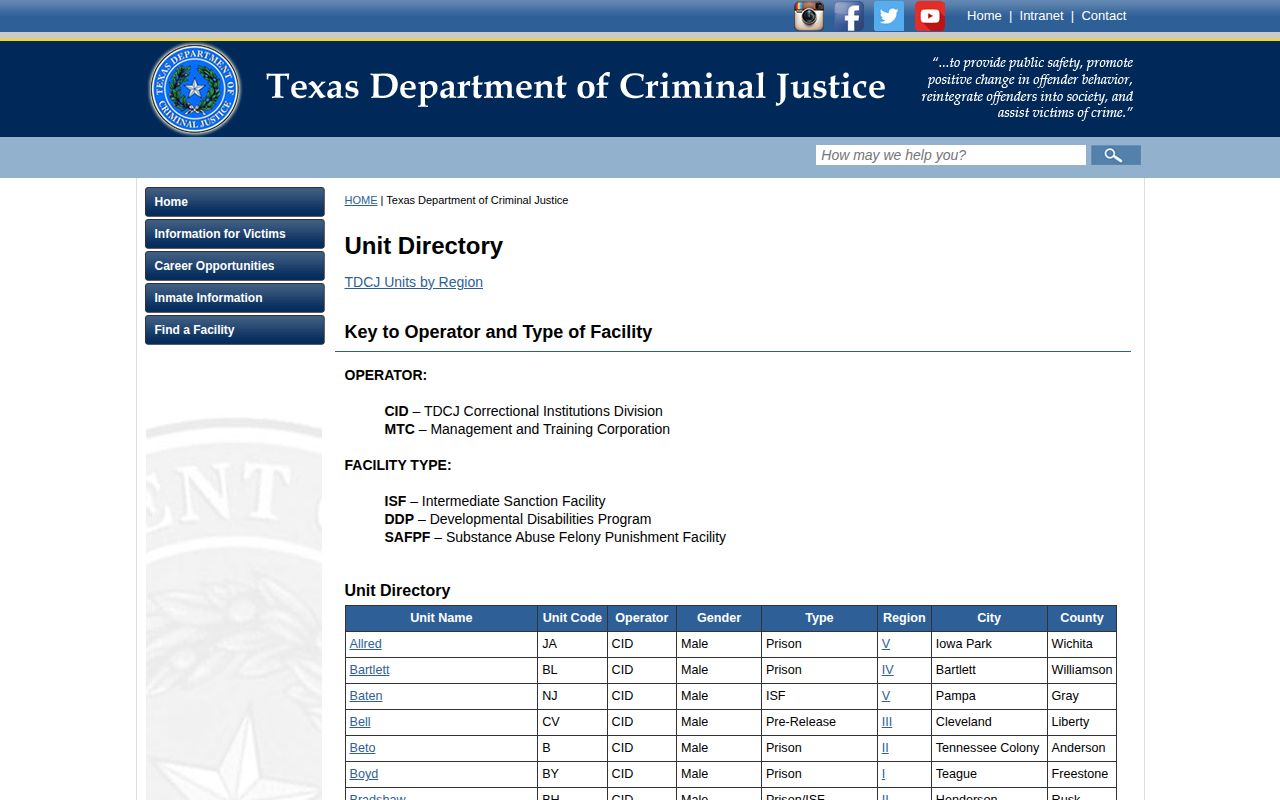
The directory confirms which Richmond units are active and prevents an old Jester I reference from being treated as a current prison record.
Fort Bend County Release Search Uses Two Clerk Systems
Court records often explain why a jail stay ended, even after the current roster entry is gone. Fort Bend misdemeanor cases use the County Clerk’s Criminal Case Records and Register of Actions. Search by case number, party, attorney, or filing date, then open the case number and read the chronology. Felony cases use District Clerk Public Access.
A local 2026 change makes fresh verification important. In February, district cases were randomly transferred to the new 501st and 502nd District Courts. Recheck the online assignment rather than relying on an older court number or hearing location. A bond order, dismissal, judgment, sentence, jail credit, or supervision order may explain the legal basis, but the sheriff record is still needed for the physical release time.
Fort Bend County Recent Release Search Has No Official Feed
An August 2, 2026 review found no official 24-hour feed, 72-hour feed, release filter, or released-person archive. The sheriff inquiry accepts names and returns current inmates only. Its approximately four-hour warning concerns processing after booking before Bonding can confirm information. It is not a roster refresh schedule and says nothing about when a release would publish.
For a recent event, search current custody, call Bonding at 281-341-4619 to ask whether the destination was street, TDCJ, or another agency, check the court case, and request the release record. Detention can be reached at 281-341-4735. The official sheriff mobile app also describes current inmate information, not a recent-release list.
Note: Same-day uncertainty should be resolved with Bonding or Detention, since a current screen cannot certify a completed release.
Released or Still Held in Fort Bend County: Where to Look
Each system answers a different question. Use the source that owns the custody event rather than assuming all Fort Bend names belong in one database.
| Situation | Best first source | What confirms it |
|---|---|---|
| Currently in county jail | FBCSO Jail Inquiry | Current booking identity and charge card |
| County booking ended | FBCSO Records or Bonding | Release time, reason, and destination tied to booking |
| Transferred to state prison | TDCJ offender search | Current facility and state record |
| Released from TDCJ | TDCJ and Parole Division | Actual release or supervision record, not projected date |
| Federal sentence | BOP Inmate Locator | Released status/date, checked for other custody |
| Immigration detention | ICE ODLS | ICE status plus detention-information follow-up |
| Juvenile matter | Juvenile court/probation | Authorized confidential channel, not adult inquiry |
A Fort Bend County Release May Be an ICE Handoff
An ICE detainer asks a local jail to notify ICE of an impending release and keep custody for up to 48 additional hours so ICE may assume custody. The request itself does not prove that ICE took the person. A Fort Bend booking may therefore end while immigration custody begins.
Check ICE’s Online Detainee Locator by nine-digit A-number and country of birth, or by exact name and country of birth. ODLS covers current detainees and certain people released from ICE within the last 60 days, but nonappearance can also reflect transfer or a record limit. The Detention Reporting and Information Line is 888-351-4024, weekdays from 8 a.m. to 8 p.m. Eastern, excluding holidays.
Digital Mail Access After Fort Bend County Release
FBCSO documents a distinctive private sign available only to the released person. After release, that person has up to 60 days to download mail through the Securus Digital Mail Download Center. A still-confined user receives an error. This can help the person recover their own mail, but it is not a public locator and does not replace the sheriff’s release record.
The sheriff documents property intake and safekeeping but does not publish an exit door, family waiting site, release schedule, gate-money policy, or post-release property pickup procedure. For an imminent event, ask Detention directly. Do not infer those logistics from practices in another county.
Two Fort Bend County Reentry Paths After Release
Fort Bend Behavioral Health Services operates Recovery & Reintegration for adults with complex behavioral-health needs. It offers individualized counseling, evaluation, and case management at no cost to participants, with referral help at 281-238-3079. This community program is distinct from parole, probation, and custody-status verification.
A separate Sheriff and AccessHealth Reentry Health Connect arrangement places a community health worker at FBCSO and begins reviewing eligible participants within 90 days before release. These two layers show why release planning may start inside the jail and continue through a county service after the custody record closes.
Fort Bend County Release Facilities and Record Paths
The county’s six facility entries include one adult jail, three active TDCJ prisons, one closed historical prison, and the confidential juvenile system. Their records must not be merged.
- Fort Bend County Sheriff’s Office Detention Facility: county booking releases go to the street, TDCJ, or another agency.
- Beauford H. Jester III Unit: an active TDCJ male prison; release and parole belong in state systems.
- Wayne Scott Unit: an active TDCJ male mental-health prison; another TDCJ or medical placement remains custody.
- Carol S. Vance Unit: an active TDCJ G1/G2 male prison; use state discharge and parole records.
- Jester I Unit: closed in 2020; research old confinement or release through TDCJ archives.
- Fort Bend County Juvenile Detention: outside the adult-inmate inquiry and subject to different confidentiality rules.