
Carol S. Vance Release Outcomes
Carol S. Vance Unit is a Texas Department of Criminal Justice Correctional Institutions Division prison for men. The official unit directory identifies G1 and G2 custody at the Richmond unit. Its published capacity is 378. These facts describe an operating state facility, not an adult county jail.
Leaving Carol S. Vance can mean transfer to another TDCJ unit, release to parole or mandatory supervision, or full discharge. A unit transfer remains incarceration. Parole and mandatory supervision place a person in the community while the sentence and state supervision continue. Discharge ends the TDCJ sentence. The current unit field and state status must be read together.
| Event | Custody result | Record route |
|---|---|---|
| Unit transfer | State custody continues | TDCJ offender search |
| Parole or mandatory supervision | Community under state supervision | TDCJ and Parole Division |
| Discharge | Sentence ends | TDCJ status or historical record |
Vance Unit Program Context
Carol S. Vance Unit hosts the InnerChange Freedom Initiative, a faith-based treatment program identified in the official directory. Program participation describes activity within state custody. It does not by itself establish parole approval, a discharge date, or release to the community. Those findings still come from the TDCJ offender, release, and parole records.
Vance shares the 933-acre Richmond complex with Jester III and Scott, yet each has its own unit code and contact. Search by TDCJ or SID number where possible to avoid confusion caused by similar locations. A move between units on the complex is a transfer, not a Fort Bend County jail release.
Confirm a Carol S. Vance Release
Use the TDCJ Online Inmate Search. Search by a seven-digit TDCJ number, SID number, or name. Read Current Facility, Projected Release Date, Parole Eligibility Date, Maximum Sentence Date, and parole-review information as separate fields. A future projected date does not prove release, and a different unit name usually means transfer.
- Match the person with a TDCJ or SID number where possible.
- Check whether Current Facility still names Carol S. Vance or another state unit.
- Read status and date fields without treating a projected date as an actual event.
- For parole, check TDCJ supervision channels. For a missing older record, request TDCJ history.
Email inmate-information questions to pia@tdcj.texas.gov. Include full name and TDCJ number, or exact birth date or approximate age and county of conviction. The general inmate locator numbers are 936-295-6371 and 800-535-0283, Monday through Friday, 8 a.m. to 5 p.m.
Carol S. Vance Release Processing
The image below comes from the official Carol S. Vance Unit directory and identifies the operating facility. TDCJ release processing is a state workflow. Release staff must resolve identification, legal status, detainers, supervision, and destination issues. County records may show the conviction that led to prison, but they do not replace TDCJ’s custody and discharge record.
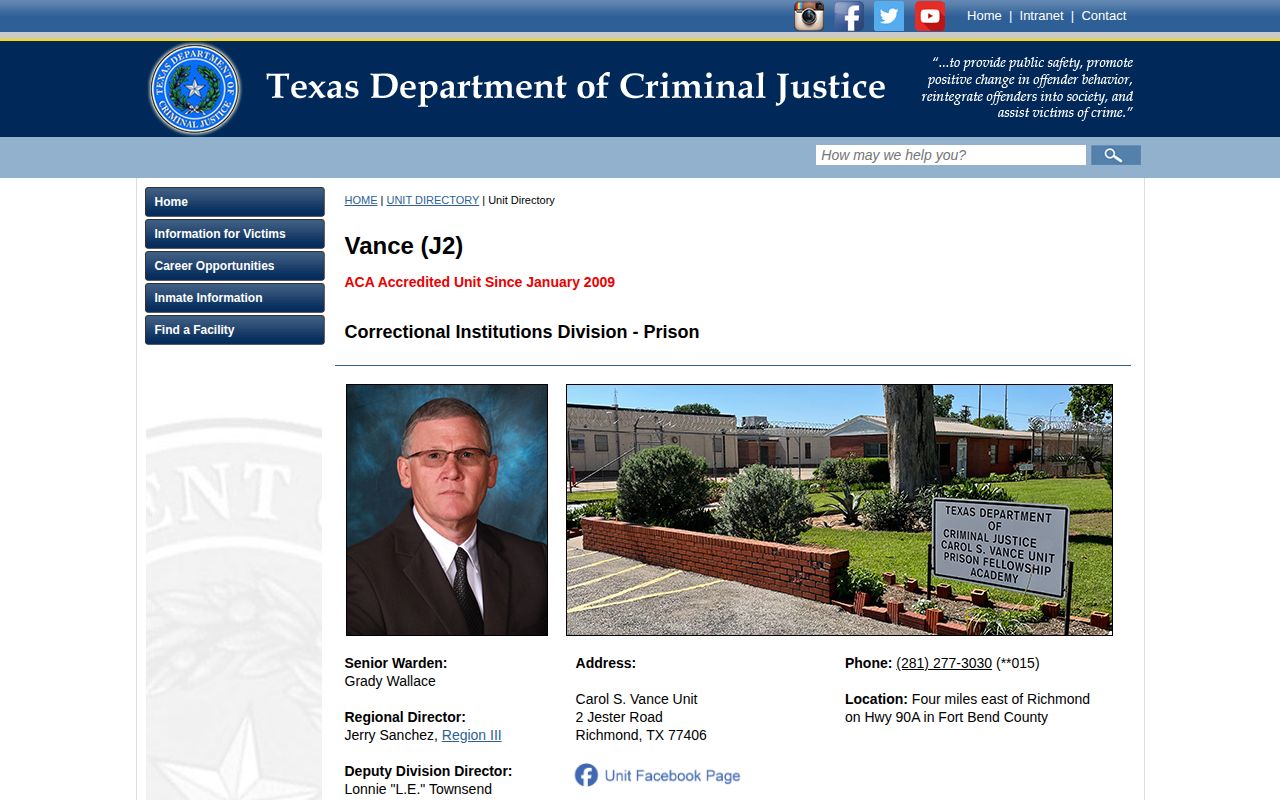
The unit source confirms Vance’s identity and program context. The statewide record confirms a transfer, supervised release, or discharge.
A detainer is another authority’s request tied to custody. It can change the destination. Release from TDCJ therefore does not always mean an unqualified return home. Confirm the recorded destination and any new custodian.
Carol S. Vance Records Contact
The unit can answer facility questions, while central TDCJ records and parole offices hold the durable statewide status trail.
Carol S. Vance Unit2 Jester Road
Richmond, TX 77406
281-277-3030
Operator: Texas Department of Criminal Justice
The official Carol S. Vance directory is the source for the unit’s current identity, address, phone, custody levels, and capacity. For historical documents, use TDCJ Public Information Act channels rather than FBCSO Records.
Fort Bend State Prison Context
Carol S. Vance sits four miles east of Richmond on Highway 90A with Jester III and Wayne Scott units. The live TDCJ directory identifies those three operating Fort Bend County state prisons. Jester I closed in 2020. Similar names in old documents can misdirect a search, so verify the unit code, J2, and the current facility field.
County court records can show the conviction and sentence. They do not show every later state transfer or release calculation. The Fort Bend released-inmate search explains when court records support a state lookup and when a county jail result addresses a wholly different custody event.
Carol S. Vance Search Fields
TDCJ date fields answer different questions. Projected Release Date is the agency’s current estimate under its legal and record calculations. Parole Eligibility Date marks when review may become possible, not an approved departure. Maximum Sentence Date reflects the sentence endpoint shown in the state record. Parole-review information reports a separate process. None should be relabeled as an actual release date unless TDCJ says the event occurred.
A fully discharged person may no longer appear in the active public population. That limit makes the historical-record route important. Write to TDCJ with the person’s full name and seven-digit number, or an exact birth date or approximate age and county of conviction. Ask for existing incarceration, transfer, release, parole, and discharge information. A precise request is more useful than asking the agency to infer a complete history.
The county of conviction is a search aid, not the release custodian. Fort Bend court files may document the sentence imposed. TDCJ maintains the later state custody trail. Keeping those roles separate prevents a county disposition from being mistaken for proof of prison release.
Carol S. Vance Parole Verification
Parole is conditional community release before the sentence has fully ended. When TDCJ records show parole, verify both the supervising office and current state status. Fort Bend County is served by the Rosenberg District Parole Office in Region III at 711 Highway 36 North, Rosenberg, TX 77471, telephone 281-232-0334. This office is not the Fort Bend County Community Supervision and Corrections Department, which administers court-ordered probation.
An absconder is a person alleged to have stopped complying with parole reporting and whose whereabouts are unknown to the Parole Division. Absconder or warrant information can change after release and may lead to later arrest. It does not change what the original prison departure meant. Use current TDCJ channels to verify the later status.
Carol S. Vance Dates and Supervision
A projected release date is TDCJ’s current calculation, not a promise. Good-conduct time, parole review, mandatory-supervision rules, disciplinary changes, court orders, and detainers may affect timing. Texas does not impose one blanket rule requiring every prisoner to serve 85 percent. Offense-specific law controls.
If the person is released to parole in Fort Bend County, the Rosenberg District Parole Office is the local TDCJ supervision office. Probation is different. It is ordered by a court and administered locally, not by Carol S. Vance or the TDCJ parole system.
Note: A move away from Carol S. Vance proves only departure from that unit until the statewide record identifies the next status.
Vance Custody Level Context
The official Vance directory identifies G1 and G2 custody. Those classifications describe prison management and living assignments. They do not promise a release date. InnerChange Freedom Initiative participation also does not substitute for a Board decision, a scheduled release record, or proof that the person left TDCJ custody. Verify each event in the statewide record.
A favorable parole vote still requires state processing. TDCJ must resolve identity, legal status, release conditions, detainers, and destination. After a favorable vote, the official release-status line is 512-406-5202. Before a vote, Board review status uses 844-512-0461. A new Current Facility entry means the person moved within state custody unless the status fields show a community release or discharge.
Carol Vance Historical Records
Fully discharged people can fall outside the active public inmate population. For that case, use the TDCJ Public Information Act process. Identify the person and ask for existing incarceration, transfer, parole, release, and discharge records. The TDCJ number is best; an exact birth date or approximate age and county of conviction can help when the number is unknown.
The fact that Vance stands in Fort Bend County does not make FBCSO the custodian of its prison release records. A county court file may prove the conviction and sentence. TDCJ holds the later state custody trail. Keeping both records in their proper roles prevents a sentence entry from being mistaken for an actual prison departure.
TDCJ’s routine inmate-information email can provide the state number, location, conviction offense, incarceration history, current information, and a projected date. It may not provide a full release packet. Ask for the actual departure date, release mode, and discharge status when those facts are needed.